
Research

Eskenazi Technology Innovation Lab Research Projects

The Influence of AI on Human Creativity Through Origami Design

Jiangmei Wu (Interior Design), Garim Lee (Merchandising), Ran Huang (Merchandising)

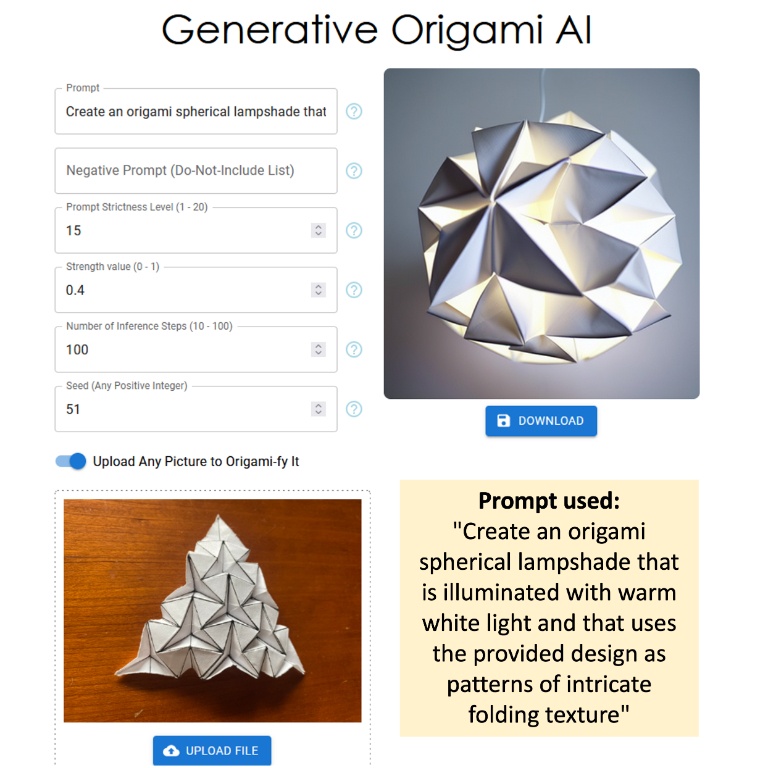
This collaborative study bridges design and social science to examine the intersection of artificial intelligence and human creativity. The team has created a Generative Origami AI to study how students use it in an advanced architecture drawing class. The project uses open-source diffusion models and addresses ongoing debate about whether AI augments or constrains human creativity. 

The study focuses on how AI tools affect origami-inspired designs created by college students. By comparing traditional design methods with AI-assisted approaches, the researchers hope to learn how generative AI supports creative processes that require understanding material properties and tactile exploration. The project uses established creativity assessment tools and examines factors including prompt linguistic style and perceived tactility. 

The team is developing Generative Origami AI as a web-based application that runs on Jetstream2, an NSF-funded resource providing virtual machines and shared software for research. Users can explore customized design alternatives and create origami-inspired designs with generative AI assistance. 
AI-Powered "StoryCatcher" Exploring Displacement Narratives

Megan Young (Digital Art)

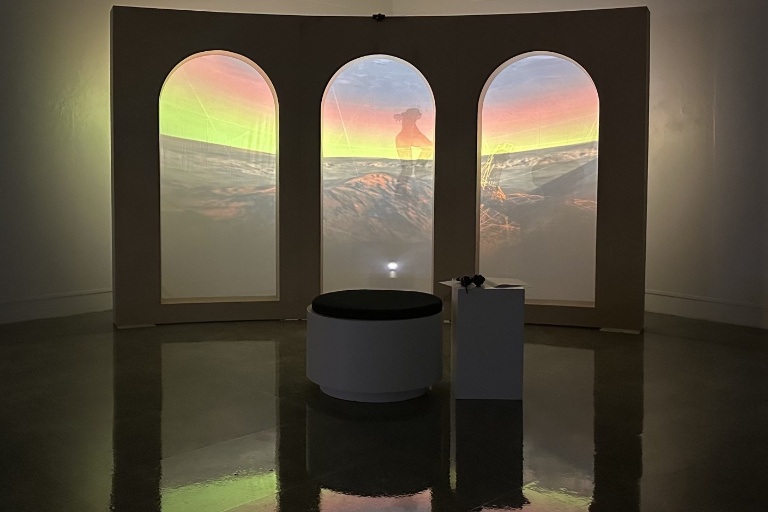
Artist Megan Young has created "Carry," an AI-powered "StoryCatcher" that brings personal narratives of displacement to life. The project combines Python-based natural language processing and retrieval-augmented generation techniques, drawing from a growing repository of personal stories collected through conversations with women from around the world. Carry operates as a dynamic, interactive archive within gallery and museum settings. She engages viewers in conversations about her journeys while inviting them to share their own experiences. 

Young's project, supported by data scientists and researchers through The Program for Faculty Assistance in Data Science (FADS), expands possibilities for empathy and connection using AI. The project continues to evolve based on research and participant feedback. It has been presented at the Grunwald Gallery, the University of North Carolina Wilmington CAB Gallery, and as a Cleveland public art project. By treating the AI as if it were raised on collective oral histories, Young creates a hybrid storytelling experience that asks viewers to reconsider displacement, shared experiences, and the potential of AI in preserving human narratives.

Who Designs Better? Crowdsourcing Jurors to Assess AI-Assisted Performance

Hoa Vo (Interior Design)

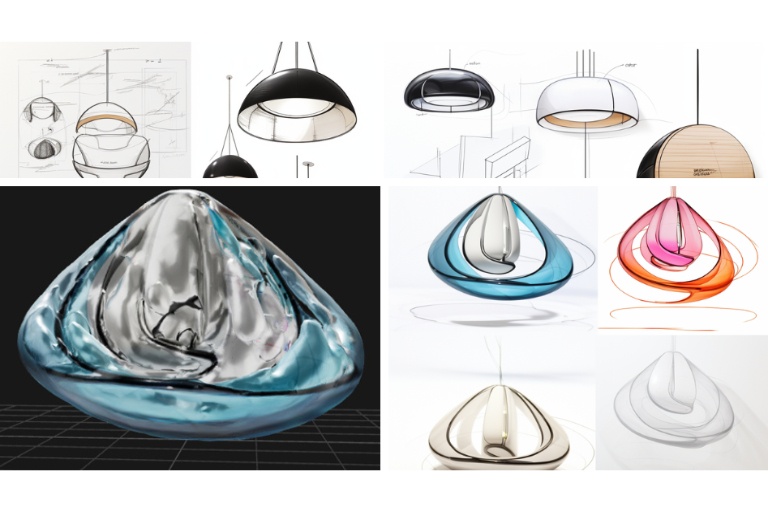
Professor Vo's studies examine the relationship between AI and human creativity in design processes. Her study "Who Designs Better? A Race Between Human and AI or Happy Co-Design" has recently concluded data analysis. The project analyzes and compares lighting products generated by AI alone, human designers using AI, and traditional human designers without AI assistance. Using the Creative Product Semantic Scale, the study revealed differences across the design approaches. 120 Amazon Mechanical Turk workers (experiment 1) and 126 Prolific workers (experiment 2) evaluated these designs as they progressed from 2D sketches to 3D renderings and finally to immersive virtual reality models. 

A second ongoing study called "Muse-Gen" expands the scope to examine the influence of AI on large-scale, complex spatial designs. Professor Vo aims to develop a generative AI model capable of producing detailed and credible museum floor plans. The study will then evaluate the creativity of these AI-generated designs through crowd-sourced assessments and expert ratings. 

Consumer Attitudes Toward AI-Generated Content

Garim Lee (Merchandising)

Professor Garim Lee's recent research examined factors influencing consumer skepticism and liking of AI-created content. Lee analyzed Reddit data and surveyed 281 U.S. participants, finding that perceived appropriateness and novelty affected both skepticism and liking. The study revealed that public ambivalence toward AI-generated ads and AI artwork operates through different dynamics. One paper was presented at the 2024 Global Fashion Management Conference, where it received the Best Conference Paper award. 

Lee's research suggests differentiated strategies for managing consumer perceptions of AI-generated content in commercial versus noncommercial contexts. For commercial AI content (customized ads, product demos), marketers should address skepticism by emphasizing ethical practices and regulatory compliance. For noncommercial AI content (artwork, museum displays), the priority should be increasing appreciation by highlighting innovation, uniqueness, and human effort in the creation process.